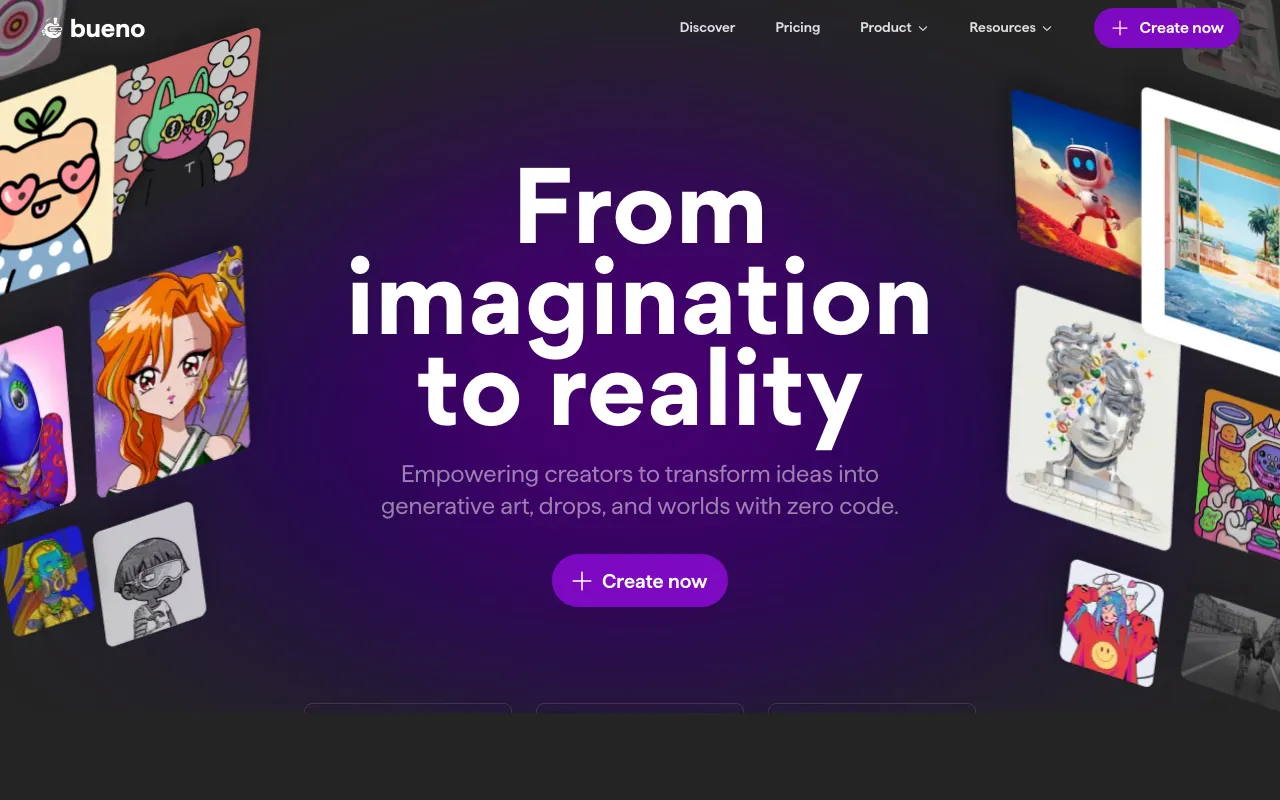
Bueno is a polished tool for NFT creators. If you are an artist who wants to generate a 10,000-piece collection from layer assets and launch it with a mint page, Bueno does that well. But it is an NFT minting platform, not a smart contract builder, and the distinction matters if your needs extend beyond JPEGs.
What does Bueno offer?
Bueno provides an end-to-end NFT launch toolkit: a generative art engine that combines layer assets into unique pieces, a no-code smart contract deployer using optimized ERC-721A contracts, custom mint page creation, allow lists, multi-phase sales, delayed reveals, and lazy minting. It even includes a “Microverse Builder” for token-gated virtual spaces.
The deployer is free (you pay gas). Bueno takes a 5% cut of primary sales. The generative art engine costs 0.00009 ETH per token. Supported chains: Ethereum, Polygon, and Base.
Where does Bueno fall short?
- NFTs only. Bueno cannot build tokens, DeFi contracts, governance systems, staking mechanisms, or any non-NFT smart contract. If your project is not an NFT collection, this tool has nothing for you.
- No custom contract logic. You configure parameters (minting rules, phases, allow lists), but you cannot add custom on-chain behavior. The contract is a fixed ERC-721A template.
- 5% sales fee. On a 1,000 ETH mint, that is 50 ETH to Bueno. This adds up significantly for successful launches.
- Three chains. Ethereum, Polygon, and Base. No Arbitrum, BSC, Optimism, or other EVM chains.
- No code visibility. You cannot see or modify the Solidity being deployed. You trust Bueno’s template.
- No testing. No simulation or debugging. You configure, deploy, and hope.
- No AI for contracts. Bueno has an AI art generator, but nothing for contract logic.
How does Doodledapp compare to Bueno?
| Bueno | Doodledapp | |
|---|---|---|
| Focus | NFT collection launches | Any smart contract |
| Contract types | ERC-721A only | Any Solidity logic |
| Custom logic | Not possible | Full visual builder |
| Art tools | Generative art engine, AI art | None (contract-focused) |
| Visual builder | None | Node-based editor |
| AI assistant | Art generation | Contract creation and modification |
| Testing | None | Visual step-through debugging |
| Code output | Hidden | Standard Solidity you own |
| Fees | 5% of primary sales | Subscription, no sales fees |
| Chains | 3 (ETH, Polygon, Base) | Major EVM chains |
When Bueno is the right choice
If your entire project is an NFT collection launch and you need generative art tooling, Bueno is purpose-built for that workflow. The layer-based art engine, mint page builder, and allow list management are polished and save real time compared to building from scratch. For a small collection where the 5% fee stays manageable, the zero-upfront-cost model is attractive. Artists who want to go from layer assets to live mint page without touching code will find Bueno efficient.
How does pricing compare?
Bueno’s 5% primary sales fee means your cost scales with success. On a 100 ETH mint, that is 5 ETH to Bueno (roughly $15,000 at current prices). On a 1,000 ETH mint, 50 ETH. Doodledapp charges a flat $99/month subscription with no per-sale fees.
For small mints, Bueno costs less. For larger launches, the subscription model saves significantly. The break-even point depends on your mint volume, but any project expecting more than a few ETH in primary sales will pay less with a flat subscription.
The bottom line
Bueno is a good tool for its specific use case: launching generative NFT collections with mint pages and allow lists. If that is all you need, it works. But if your project involves any smart contract logic beyond a standard NFT mint, or if you want to see and control what your contract does, or if paying 5% of your revenue to a platform does not sit well with you, Doodledapp offers a fundamentally more capable and transparent approach.