
If you have searched for no-code smart contract tools, you have probably come across CryptoDo. It promises to let you build verified smart contracts in five minutes without programming skills. That sounds great on paper. But what does it actually let you build?
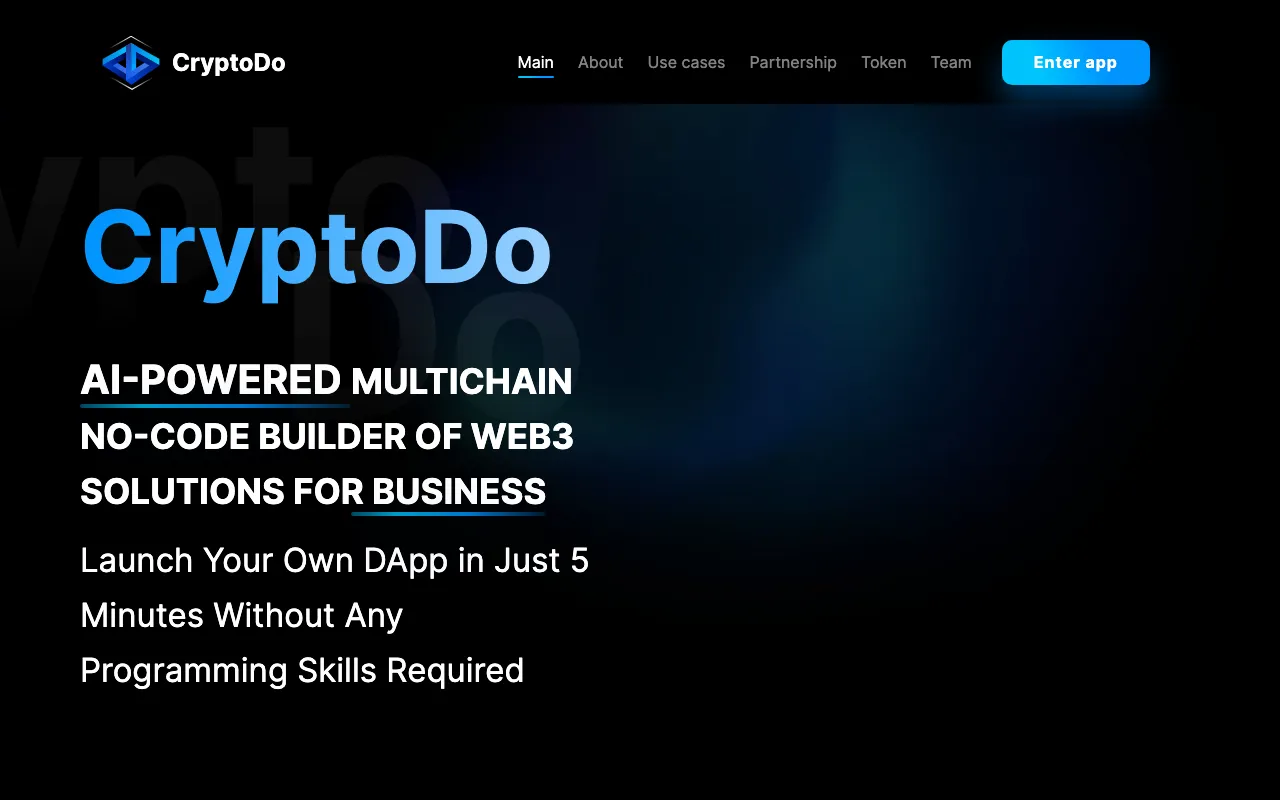
What does CryptoDo offer?
CryptoDo is a template-based platform. You pick a contract type (ERC-20 token, NFT, crowdsale, staking, DAO) and fill in a form with your parameters: name, supply, fees, that sort of thing. The platform generates a contract from a fixed template and deploys it.
It supports multiple EVM chains, and the interface is simple if you already know exactly which template you need.
Where does CryptoDo fall short?
The core limitation is that you cannot build anything outside the templates. If your contract needs custom logic, a unique reward calculation, a non-standard access control pattern, or any business rule that does not fit neatly into one of their predefined categories, you are stuck. You either compromise your design or go hire a developer anyway.
A few other issues to keep in mind:
- Wallet-only login. CryptoDo requires a crypto wallet to sign in. If your target user is a non-technical founder who does not have MetaMask installed, you have already lost them at the door.
- Unclear pricing. The platform uses a native CDO token for payments, but pricing details are not publicly listed. You cannot easily compare costs before committing.
- Signs of abandonment. Their YouTube channel has 250 subscribers and 13 videos. The last upload was over a year ago. Gateway errors have been reported when attempting to log in.
There is no visual builder, no way to see the logic of your contract laid out as a flow, and no testing or debugging tools.
There is also no way to preview what your contract will look like before deploying it. You fill in a form, the platform generates code behind the scenes, and you deploy it. If the generated code does not match your expectations, you would need to read the Solidity output yourself to verify it, which defeats the purpose of a no-code tool.
For teams, there is no collaboration layer. A single person configures the contract, and there is no shared workspace, version history, or team review process.
Who is CryptoDo best for?
CryptoDo works for someone who needs a standard token or NFT contract, already has a crypto wallet, and does not need any custom logic. If your project fits neatly into one of their templates and you just need to fill in the blanks, it can save time. The problem is that most real projects outgrow templates quickly. The moment you need a custom reward distribution, a tiered access system, or business logic that does not map to a predefined category, the template approach breaks down.
This is the fundamental trade-off with template-based builders. They are fast when your needs are generic, and useless when they are not.
How does Doodledapp compare?
Doodledapp takes a fundamentally different approach. Instead of picking from a menu, you build your contract logic visually by connecting nodes on a canvas, the same way game developers wire up gameplay logic in Unreal Engine.
| CryptoDo | Doodledapp | |
|---|---|---|
| Approach | Fill-in-the-blank templates | Visual node-based builder |
| Custom logic | Not possible | Build anything Solidity supports |
| Output | Pre-built contract from template | Standard Solidity you own |
| Visual flow | None | Full node graph of your logic |
| AI assistant | Minimal | Describe changes in plain English |
| Testing | None | Visual test runner with step-through debugging |
| Login | Wallet only | Email, Google, or GitHub |
| Pricing | Opaque (CDO token) | Free tier available, transparent plans |
Which should you choose?
CryptoDo works if you need a standard ERC-20 token and nothing else. The moment your project requires anything custom, you hit a wall. Doodledapp does not have that wall. You get a visual canvas where you can build any Solidity logic, see exactly what your contract does, test it before deploying, and export clean, standard Solidity code with no vendor lock-in.