
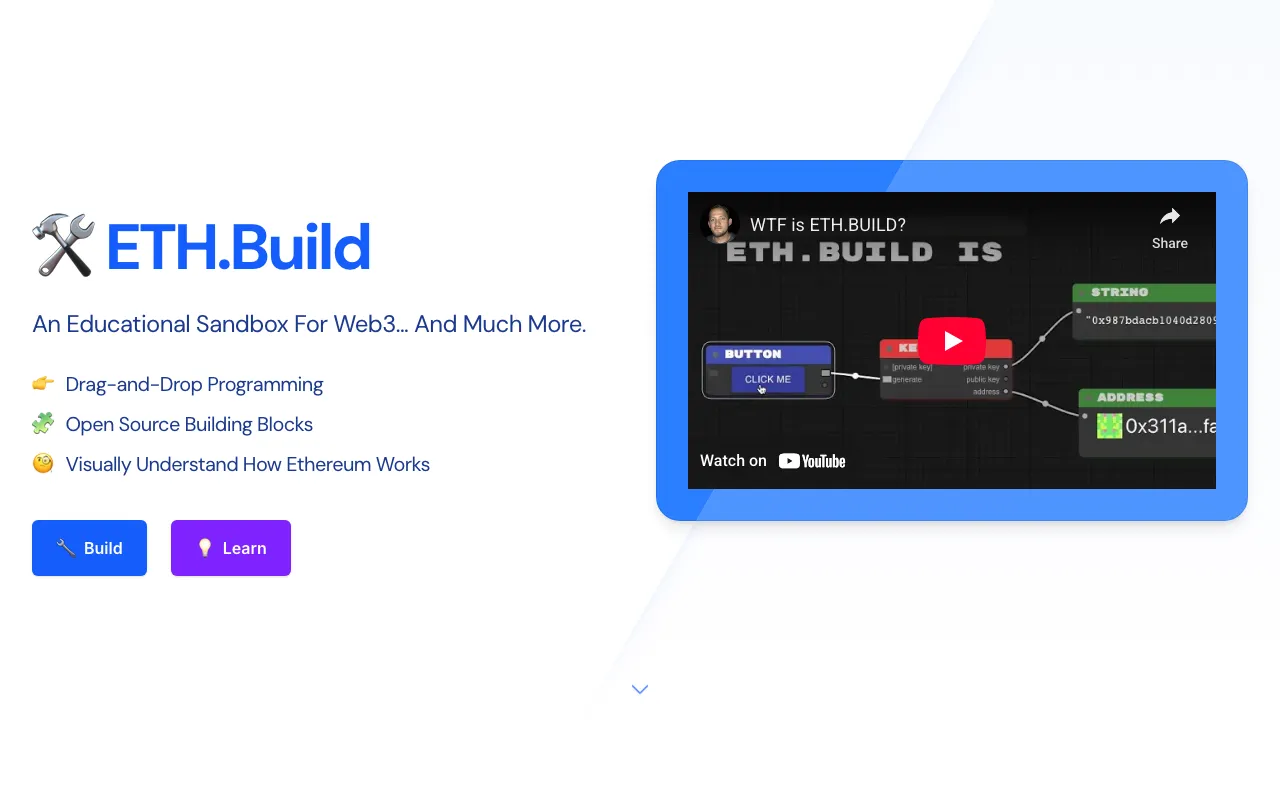
ETH.Build is one of the most creative educational tools in the Ethereum ecosystem. Created by Austin Griffith, it lets you drag and drop building blocks to visually explore how hashing, key pairs, transactions, and smart contracts work under the hood. It is free, open source, and genuinely fun to use. But it was designed to teach you Ethereum, not to build contracts on it.
What does ETH.Build offer?
ETH.Build is an interactive sandbox where you connect visual blocks to simulate Ethereum concepts. You can wire together hash functions, key pair generators, encryption blocks, and transaction signers to see how data flows through the system. There are guided tutorials covering topics like cryptographic hashing, public/private key pairs, Byzantine consensus, and basic smart contract interaction.
The tool is completely free, open source under the MIT license, and requires no account to use. It is part of a broader learning path that includes SpeedRunEthereum for hands-on challenges and Scaffold-ETH for development scaffolding.
The sandbox environment at sandbox.eth.build lets you experiment freely, connecting blocks and watching values propagate in real time. It is an excellent way to build intuition for how Ethereum actually works at a protocol level.
Where does ETH.Build fall short?
ETH.Build is a teaching tool, and its limitations reflect that scope. If you are looking to create a smart contract, here is where it stops:
- No contract generation. ETH.Build does not produce Solidity code. The blocks simulate Ethereum concepts, but they do not compile into deployable contracts.
- No custom logic building. You cannot define functions, state variables, access control, or business logic. The blocks represent protocol primitives like hashing and signing, not contract constructs.
- No compilation or deployment. There is no build step, no compiler, and no way to deploy anything to a network. The output stays within the sandbox.
- No testing framework. You can observe how data flows between blocks, but there is no way to simulate contract execution, trace function calls, or debug logic.
- No AI assistance. There is no natural language interface for modifying or generating anything. Interaction is limited to dragging and connecting blocks.
- Concept-level only. The tool covers how Ethereum works (hashing, signing, consensus) but not how to build things on Ethereum (writing contracts, defining logic, handling state).
ETH.Build also has not received significant updates in recent years. The repository is open source but not actively maintained with new features. The tutorials cover foundational concepts well, but they do not extend into newer Ethereum developments like Layer 2 chains, account abstraction, or recent Solidity patterns.
For someone learning Ethereum basics, this is fine. For someone trying to understand the current development landscape, the content may feel dated.
How does Doodledapp compare?
ETH.Build and Doodledapp both use visual, node-based interfaces, but they serve completely different purposes. ETH.Build helps you understand the Ethereum protocol. Doodledapp helps you build smart contracts that run on it.
| ETH.Build | Doodledapp | |
|---|---|---|
| Purpose | Learn how Ethereum works | Build smart contracts |
| Approach | Drag-and-drop concept sandbox | Visual node-based contract builder |
| Output | Visual simulation | Deployable Solidity code |
| Custom logic | Not supported | Build anything Solidity supports |
| Smart contract creation | No | Full contract builder |
| Compilation | None | Built-in Solidity compiler |
| Deployment | None | Multi-chain EVM deployment |
| AI assistant | None | Plain English contract modifications |
| Testing | Observe data flow in sandbox | Visual step-through debugging |
| Target user | Learners new to Ethereum | Anyone building contracts |
| Pricing | Free | Free tier available |
Can you use both together?
These tools are not competitors. They are different stages of learning and building. ETH.Build is where you go to understand what a hash function does, how a private key signs a transaction, or why consensus matters. Doodledapp is where you go once you are ready to build something real.
If you are just getting started with Ethereum, ETH.Build is a fantastic first step. It gives you the mental models you need to understand what smart contracts actually do at a protocol level. When you are ready to create your own contract, define custom logic, test it, and deploy it, that is where Doodledapp picks up.
Which should you choose?
ETH.Build is one of the best educational tools in the Ethereum space. If you want to understand how blockchain technology works under the hood, spend time in the sandbox. But when you are ready to move from learning to building, you need a tool that produces real, deployable code. Doodledapp takes the same visual, node-based approach that makes ETH.Build intuitive and applies it to actual smart contract development, from logic design through testing and deployment.