
OpenZeppelin Wizard is the gold standard for config-based contract generation. It is free, backed by the most trusted name in smart contract security, and produces clean code built on battle-tested OpenZeppelin libraries. If you are a developer who needs a well-structured starting point, it is excellent. But it is explicitly a starting point, not a builder.
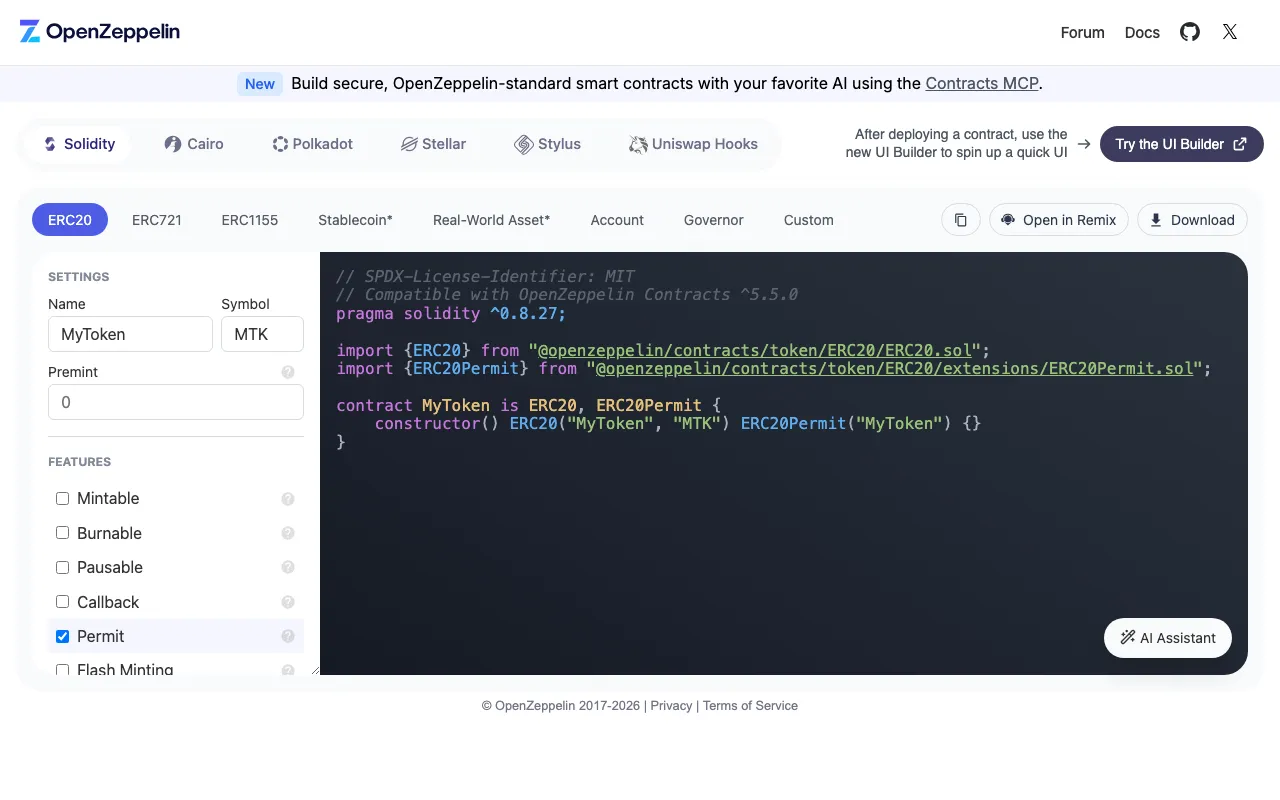
What does OpenZeppelin Wizard offer?
The Wizard is a web interface where you select a contract type (ERC-20, ERC-721, ERC-1155, Stablecoin, RWA, Governor, Account, and more), then toggle features like mintable, burnable, pausable, and access control. It generates the complete Solidity code using OpenZeppelin’s audited library. The output is clean, well-structured, and ready to compile.
It is completely free, open source, and does not require an account.
Where does OpenZeppelin Wizard fall short?
- Code generation only. The Wizard produces Solidity code. It does not compile, test, or deploy it. You copy the code into Remix, Hardhat, or Foundry and take it from there.
- No custom logic. You can toggle features on and off, but you cannot add custom business logic within the Wizard. The “Custom” option gives you a bare contract with optional access control, upgradeability, and pausability toggles. Any real logic must be added by hand after export.
- Developer-only. The output assumes you can read and extend Solidity. A non-technical founder looking at the generated code has no way to understand what it does without developer help.
- No visual representation. You see the code, not the logic. There is no flow diagram, no node graph, no way to trace execution visually.
- No testing. The Wizard has no simulation, debugging, or test execution. You need a separate testing environment.
- AI assistant. The Wizard added a built-in AI assistant in 2023 that lets you modify contracts through natural language. OpenZeppelin also released Contracts MCP in early 2026, connecting any AI tool to their contract library. These are useful additions, though the AI modifies code rather than visual logic.
How does Doodledapp compare?
OpenZeppelin and Doodledapp are complementary more than competitive. The Wizard gives you a great foundation. Doodledapp lets you build on top of that foundation visually.
| OpenZeppelin Wizard | Doodledapp | |
|---|---|---|
| Approach | Toggle features, generate code | Visual node-based builder |
| Custom logic | Must add by hand (in Solidity) | Build visually on canvas |
| Output | Solidity code (copy/paste) | Solidity code (export) |
| Code quality | Industry-standard OZ libraries | Standard Solidity |
| Visual builder | None | Full node graph |
| AI assistant | Built-in AI + Contracts MCP | Plain English modifications |
| Testing | None | Visual step-through debugging |
| Compilation | None (external) | Built-in compilation |
| Deployment | Via Defender plugin (sunsetting July 2026) | Multi-chain deployment |
| Target user | Developers | Anyone |
| Pricing | Free | Free tier available |
OpenZeppelin contracts are a first-class citizen in Doodledapp
This is not an either/or choice. OpenZeppelin’s audited contracts and interfaces are built directly into Doodledapp’s package system. You can browse, select, and import any OpenZeppelin contract with a single click.
Want to inherit from ERC-20, add Ownable, or use ReentrancyGuard? Just import the package and it is automatically available in your contract, ready to extend with your own custom logic.
No extra wiring or configuration needed. For example, building an ERC-20 token with custom minting logic looks like this: open the package browser, search “OpenZeppelin ERC20”, click import. The contract appears in your workspace with all standard functions (transfer, approve, balanceOf) already wired.
Now add your custom logic visually: drag a Function node for your mint function, connect a Require node to check that the caller is the owner, connect a Call node to the inherited _mint function. You never touch the ERC-20 implementation code, but you can see exactly how your custom logic connects to it.
You get the security of OpenZeppelin’s battle-tested code and the flexibility of Doodledapp’s visual builder, together.
A practical workflow comparison
With the Wizard alone, a non-developer’s journey looks like this: configure toggles, copy the generated Solidity, hand it to a developer to add custom logic, wait for them to set up Hardhat or Foundry, write tests, compile, and deploy. Every step after the Wizard requires technical knowledge.
With Doodledapp, the same person imports the OpenZeppelin base contract, builds custom logic visually on the canvas, tests it with the visual step-through debugger, compiles, and deploys, all in one interface. The OpenZeppelin security is identical in both cases. The difference is who can do the work.
The bottom line
OpenZeppelin Wizard is the best tool in its category. If you are a Solidity developer who needs a clean, audited starting point for a standard contract type, use it. But “starting point” is the key phrase. The Wizard gives you the scaffolding.
You still need to write the custom logic, set up a test environment, compile, and deploy. Doodledapp handles that entire pipeline visually, from building custom logic through testing and deployment, in one place.