WP Smart Contracts takes an unusual approach to the no-code contract space: it is a WordPress plugin. If you already run a WordPress site and want to add token functionality or an NFT marketplace, the idea of doing it from your existing dashboard sounds convenient. But convenience and capability are not the same thing.
What does WP Smart Contracts offer?
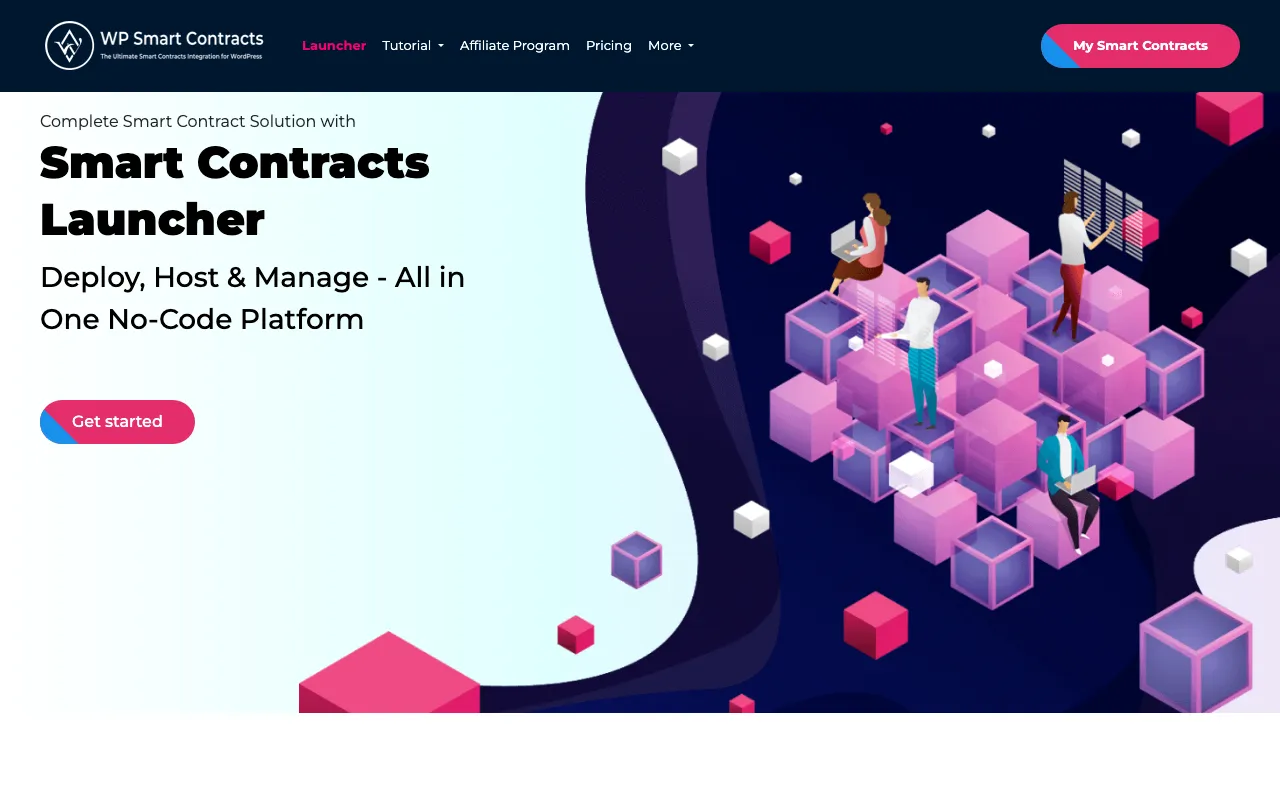
The plugin lets you deploy smart contracts directly from your WordPress admin panel. It covers a handful of contract types: ERC-20 and BEP-20 tokens, NFT collections and marketplaces, staking contracts, and crowdfunding campaigns. Each type comes in different “flavors” (tiers) with varying feature sets. It also auto-generates a hosted web interface for your deployed contract.
Pricing is per contract, ranging from free (basic token) up to around $600 for premium NFT marketplace flavors. Prices are denominated in ETH so they fluctuate with the market.
Where does WP Smart Contracts fall short?
- WordPress dependency. You need a WordPress site to use this tool. That is a non-trivial requirement and a strange coupling for smart contract development.
- Pure templates. You pick a type, fill in parameters, and deploy. There is no way to add custom logic, modify the contract behavior, or see what the contract actually does under the hood.
- Per-contract costs add up. Deploying a staking contract might cost $300-600 depending on the flavor. If you need multiple contracts, the costs compound quickly.
- No code visibility. You cannot see or modify the Solidity being deployed. You are trusting a WordPress plugin with your on-chain logic.
- No testing. There is no way to simulate or test contract behavior before deployment.
- No AI. No natural language interaction, no smart suggestions, no automated modifications.
How does Doodledapp compare to WP Smart Contracts?
| WP Smart Contracts | Doodledapp | |
|---|---|---|
| Approach | WordPress plugin with templates | Standalone visual builder |
| Platform dependency | Requires WordPress | None (runs in the browser) |
| Custom logic | Not possible | Build anything Solidity supports |
| Code visibility | Hidden | Full Solidity output you own |
| Pricing | $5-$600 per contract (ETH-denominated) | Subscription with free tier |
| AI assistant | None | Plain English modifications |
| Testing | None | Visual step-through debugging |
| Deployment | From WordPress dashboard | Multi-chain deployment |
When does WP Smart Contracts make sense?
WP Smart Contracts has a narrow but valid use case. If you run a WordPress site and want to add a basic token or crowdfunding widget without leaving your existing dashboard, it delivers on that promise. The auto-generated frontend means you can have a working deployment page alongside your existing content in minutes.
The per-contract pricing model also means you only pay for what you deploy. If you need one simple ERC-20 token and never plan to iterate on the logic, the one-time cost of the basic tier is less than a month of any subscription tool. For that specific scenario, the economics work.
What are the risks of building contracts inside WordPress?
The WordPress dependency creates a risk most founders overlook. WordPress sites require ongoing maintenance: plugin updates, PHP version compatibility, hosting management, security patches.
Your smart contract deployment infrastructure is now tied to your CMS uptime and security posture. If your WordPress site gets compromised (WordPress accounts for over 90% of hacked CMS sites), your contract deployment pipeline is part of the attack surface.
There is also the question of team collaboration. WordPress admin access is not designed for smart contract development workflows. There is no version control, no review process, no staging environment for contract changes.
One team member clicks “deploy” from the WordPress dashboard, and the contract is on-chain. For production contracts handling real value, this level of deployment control is inadequate.
Doodledapp separates contract development from any external platform dependency. Your contracts live in a purpose-built visual builder with testing, AI assistance, and a deployment pipeline designed specifically for smart contracts.
The bottom line
WP Smart Contracts solves a specific problem for WordPress site owners who want basic blockchain functionality with minimal effort. If that is your situation and a standard ERC-20 token is all you need, it works. But if you want to actually understand and control what your contract does, build custom logic, test before deploying, or work outside the WordPress ecosystem, Doodledapp gives you all of that without the platform lock-in.